


Performance requirements that align people with strategic deliverables.
The RPA-Cube is a proven assessment that helps organisations clearly position result areas within roles and functions, creating a shared understanding of what performance actually requires.

What is the RPA-Cube?
The RPA-Cube is a behavioural and performance-oriented methodology that visualises the result positioning areas of a role, function or set of responsibilities. It translates abstract job descriptions into concrete performance requirements.
Instead of focusing on activities or personal preferences, the RPA-Cube focuses on what needs to be delivered, what kind of contribution this requires, and where that contribution sits within a broader performance context.
Instead of focusing on activities or personal preferences, the RPA-Cube focuses on what needs to be delivered, what kind of contribution this requires, and where that contribution sits within a broader performance context.

Attachment
Shows whether delivering this result area primarily requires a focus on content and expertise or on relationships and people.

Exploration
Indicates whether the result area is more focused on optimising what already exists or on exploring and shaping what comes next.

Interdisciplinarity
Reveals whether achieving the result area requires a specialist focus or a generalist, integrative contribution.
Why these constructs matter
Together, these dimensions create a clear, shared performance language. Many performance issues do not stem from a lack of talent, but from unclear or conflicting expectations. When result areas are poorly defined or implicitly assumed, roles become overloaded, fragmented or misaligned.
By clearly defining and positioning result areas, the RPA-Cube creates clarity about what outcomes are truly essential, the kind of contribution required to achieve them and whether these result areas realistically fit within one role or should be distributed.
By clearly defining and positioning result areas, the RPA-Cube creates clarity about what outcomes are truly essential, the kind of contribution required to achieve them and whether these result areas realistically fit within one role or should be distributed.
The Growth-Curve
Every organisation, team and project is constantly evolving along a pattern called the Growth-Curve: an initial period of slow growth characterised by a focus on renewal and innovation, followed by a period of growth acceleration and a focus on operational excellence, and lastly a period of slowing growth and a focus on optimisation. Understanding this Growth-Curve allows you to recognize current and upcoming strategic challenges and priorities for your organisation.
The RPA-Cube with the Growth-Curve
The RPA-Cube visualises where different result areas contribute within the Growth-Curve. This allows you to see which phases of growth a role, function or team is expected to support, and whether these result areas together enable effective execution across all phases.
The horizontal axis displays progress in time and the vertical axis represents growth.
The horizontal axis displays progress in time and the vertical axis represents growth.

How the RPA-Cube works across
individual, team and organisational levels
The RPA-Cube provides insight at multiple levels, helping organisations align people’s contributions and their strategic priorities from the ground up.

Individual level
Role clarity and contribution.
Gain clarity on whether your current result areas fit your natural contribution, helping you understand where you add the most value and where friction or overload may arise.
Key application
- Role clarity and expectation management.
- Career and role fit reflection.
- Coaching around contribution and focus.
- Dialogue on responsibilities and priorities.
Typical insights
- Fit between person and result areas.
- Sources of energy and drain in the role.
- Conflicting or overloaded contributions.
- Preferred types of contribution to results.

Team level
Alignment of roles and results.
Make visible how result areas are distributed across a team, revealing overlaps, gaps or tensions that affect collaboration and collective execution.
Key application
- Role design and task distribution.
- Team performance alignment.
- Reducing overload and ambiguity.
- Improving execution flow.
Typical insights
- Clustering or spread of result areas.
- Missing or overrepresented contributions.
- Role-related friction points.
- Opportunities for clearer ownership.

Organisational level
Execution structure and focus.
Understand how result areas are structured across functions and departments, supporting sharper execution, better role design and strategic coherence.
Key application
- Function and job design.
- Recruitment and succession planning.
- Organisational restructuring.
- Strategy-to-execution alignment.
Typical insights
- Structural execution gaps.
- Misaligned or overloaded roles.
- Consistency across similar functions.
- Strategic focus versus operational reality.
What organisations gain from using the RPA-Cube
The RPA-Cube helps organisations clarify what results need to be delivered, align roles accordingly and strengthen execution across functions and teams.
Real-World Applications
The RPA-Cube is used in a wide range of practical contexts where clarity on roles, responsibilities and results is essential. From individual roles to leadership teams and organisational design, it helps translate strategy into clear, executable contributions.
Individual Performance
Apply the RPA-Cube in coaching, development and role conversations to clarify what an individual is expected to deliver. By making result areas explicit, it becomes easier to see where someone thrives, where energy is lost and how responsibilities can be reshaped for better performance.
Team
Performance
Use the RPA-Cube to explore how result areas are divided and shared within a team. This makes it easier to spot overlaps, blind spots or tensions between roles and to improve collaboration by clarifying ownership and expectations across the team.
Organisational Performance
Use the RPA-Cube to analyse how result areas are structured across functions and departments. This provides insight into whether the organisation is set up to support its strategy and where adjustments in role design or structure are needed to strengthen execution.

Leadership Performance
Use the RPA-Cube with leaders to create sharper focus on priorities, responsibilities and decision-making. It supports leaders in balancing operational and strategic result areas and helps leadership teams align on who is accountable for what in driving results.
Get certified to work with the RPA-Cube
Our concise yet thorough certification process ensures that you get a deep understanding of the underlying behavioural constructs, can interpret profiles accurately, and apply the insights responsibly and effectively in development, coaching and team settings. This allows you to use the RPA-Cube completely independently, either in your own organisation or as an advisor for your clients.
Human Insight Academy
A self-paced online programme that guides you through the RPA-Cube framework using video modules, assignments and an exam. This pathway is ideal for individuals or distributed teams who prefer flexible learning with structured guidance.

In-person certification
A one and a half-day interactive training led by an RPA-Cube certification expert. This format includes hands-on exercises, case simulations and direct feedback followed by an exam to build confidence and skill in applying the RPA-Cube in real organisational situations.

Human Insight Platform
Once certified, practitioners gain access to the Human Insight Platform, where they can administer assessments, generate reports and apply the RPA-Cube across individuals, teams and organisations.
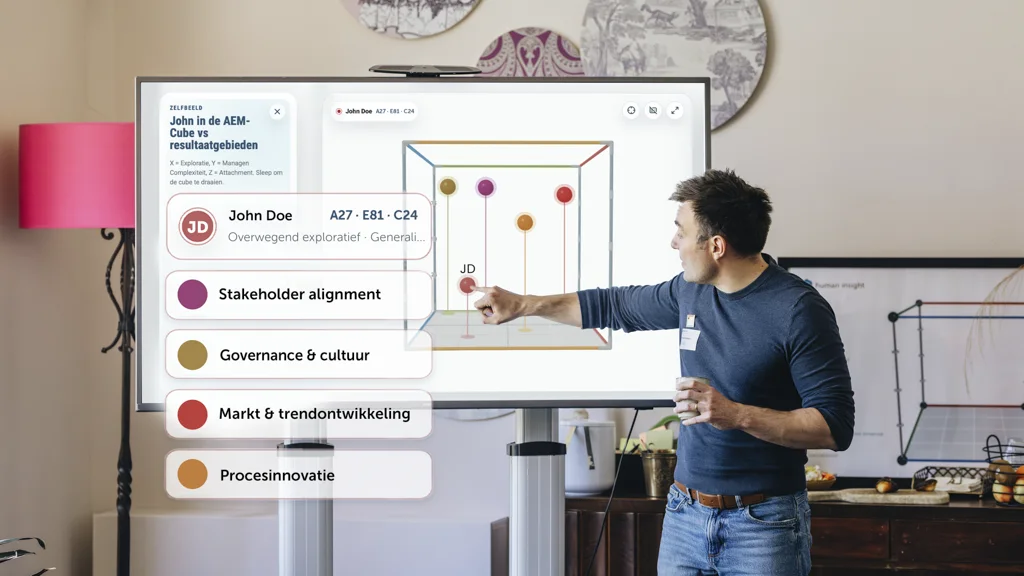
What the RPA-Cube process looks like
The RPA-Cube is an online assessment that fits smoothly into development, team and organisational programmes.

Define result areas
Together with stakeholders, clear and meaningful result areas are formulated.

Complete the assessment
Participants assess the nature of each result area via focused questionnaires.

Visualise the outcomes
Result areas are positioned in the RPA-Cube, revealing patterns and tensions.
Translate into action
Insights are used to refine roles, redistribute responsibilities or guide decisions.
Assessing an entire team can be done in a matter of days, from initial contact to explaining the process, filling in the questionnaires and debriefing the results and putting these insights into practice. This can be done by a trainer or advisor, a business leader or even a member of the team.
Comprehensive reporting and insights
The RPA-Cube provides structured insights into result areas at individual, team and organisational levels.
Individual level
- Clear overview of assigned result areas and their positioning in the RPA-Cube.
- Visual representation across attachment, exploration and managing complexity.
- Insight into fit, tension or overload within a role.
- Individual self-reporting and multi-stakeholder input available.
Team level
- Visual mapping of result areas across team members.
- Analysis of overlaps, gaps and spread of result areas.
- Identification of execution risks and role-related friction points.
- Concrete input for role clarification and team performance alignment.
Organisation level
- Organisation-wide overview of result-area distribution.
- Insight into structural execution gaps and bottlenecks.
- Alignment between strategy, role design and execution capacity.
- Practical input for organisational design and development decisions.
Trusted by organisations and institutions worldwide
RPA-Cube is grounded in over 30 years of behavioural science and used across industries.

Research Foundation
- Evidence-based behavioural frameworks linking insight to business performance
- Referenced in academic and management literature
- Proven impact on alignment, adaptability and sustainable growth
30+
Years of validated assessments
20+
Years of research
80,000+
Supported individuals
1,200
Organisational applications worldwide


Contact Information
Tell us briefly what you are looking to improve, explore, or solve. Our team will review your request and get back to you with relevant information or next steps.
If your inquiry relates to a potential project, partnership, or service, include a few details about your company and goals so we can respond more effectively.
Are you ready to put our insights into practice?
Reach out to learn more about the RPA-Cube, how it works, what it can do for you or just to share ideas.