
Quality of Interaction: measure and improve how your team collaborates
The Quality of Interaction (Qi) assessment provides HR leaders, L&D professionals and team managers with deep insights into how teams work together, specifically focusing on improving meeting effectiveness and collaboration quality. Unlike the ACT-Cube®, which maps overall team culture and behaviour, this specialised tool assesses the effectiveness of daily interactions. By analysing how cognitive diversity is expressed, how safe people feel to share perspectives and how capable the organisation is of responding to challenges, it highlights the exact conditions that enable innovation, adaptability and high-quality decision-making.

What Quality of Interaction measures
Quality of Interaction visualises three dimensions that determine how well people are collaborating, sharing ideas and responding to change.

Cognitive Diversity
The differences that people see within their organisation in how they percieve the world, process information and recognise opportunities.


Why these concepts matter for performance
Interaction patterns shape how well people collaborate, make decisions and generate new ideas. Cognitive diversity brings multiple perspectives to problem-solving. Psychological safety ensures people can voice those perspectives. The generative factor predicts how adaptable and innovative the organisation can be. Together, these dimensions give actionable insights into what people should do on a behavioural level to improve their interactions, which will drive organisational performance and strategic execution.
How Quality of Interaction adds value for individuals, teams and organisations
Qi provides insight at multiple levels throughout the organisation by stimulating and developing optimal behaviours from the ground up.

iQi
Personal insight and development.
Understand how personal preferences are expressed in interaction, how comfortable someone feels sharing ideas and how their communication contributes to psychological safety.
Key application
- Personal effectiveness.
- Coaching.
- Communication awareness.
- Leadership styles.
Typical insights
- How someone expresses cognitive differences.
- Helping people feeling safe enough to speak up.
- How others experience your communication.
- Personal contribution to team climate.

Team Qi
Collective patterns and dynamics
Reveal how groups exchange ideas, where interaction patterns enable or block adaptability and which dynamics are helping or hindering psychological safety.
Key application
- Team development.
- Collaboration patterns.
- Conflict resolution.
- Improving problem solving.
Typical insights
- Expression of cognitive diversity at team level.
- Interaction patterns that are restricting openness.
- Exposing sources of friction.
- Conditions that enable productive dialogue.

Organisational Qi
Strategic patterns and culture
Identify which behavioural patterns are influencing adaptability, innovation capacity and execution effectiveness across a department or an entire organisation.
Key application
- Cultural transformation.
- Change readiness.
- Organisational adaptability.
- Leadership capability analysis.
Typical insights
- Psychological safety climate across departments.
- Expression of cognitive diversity across your organisation.
- Leadership’s influence on interaction patterns.
- Generative capability for future challenges.
What organisations gain from using Qi
Quality of Interaction supports organisations in developing stronger collaboration, higher adaptability and a healthier organisational culture.
Real-world applications
The Quality of Interaction assessment strengthens performance in talent, teams, leadership and organisation-wide development.
Get certified to work with Qi
Our concise yet thorough certification process ensures that you get a deep understanding of the underlying behavioural constructs of Qi. After getting certified, you will be able to interpret profiles accurately and apply the insights effectively, wheter it's in development, coaching or team settings. Completing the course allows you to use Qi completely independently, either in your organisation or as an advisor for your own clients.
Human Insight Academy
An online programme that guides you through the Qi framework using video modules, assignments and an exam. This pathway can be followed at your own pace and is ideal for individuals or distributed teams who prefer flexible learning with structured guidance.

In-Person Certification
A one and a half-day interactive training led by a Qi certification expert. This format includes hands-on exercises, case simulations and direct feedback followed by an exam, building confidence and skill in applying Qi in real organisational situations.

Human Insight Platform
Once certified, practitioners gain access to the Human Insight Platform, where they can administer assessments, generate reports and apply Qi across individuals, teams and organisations.
How to work with Qi
Quality of Interaction follows four clear steps.

Invite participants
Individuals receive a secure online invite to complete the Qi questionnaire at a time that suits them.

Complete the assessment
Participants answer a series of questions reflecting on their own behaviour or that of the people around them. The assessment usually takes no more than 10 minutes.
Receive report
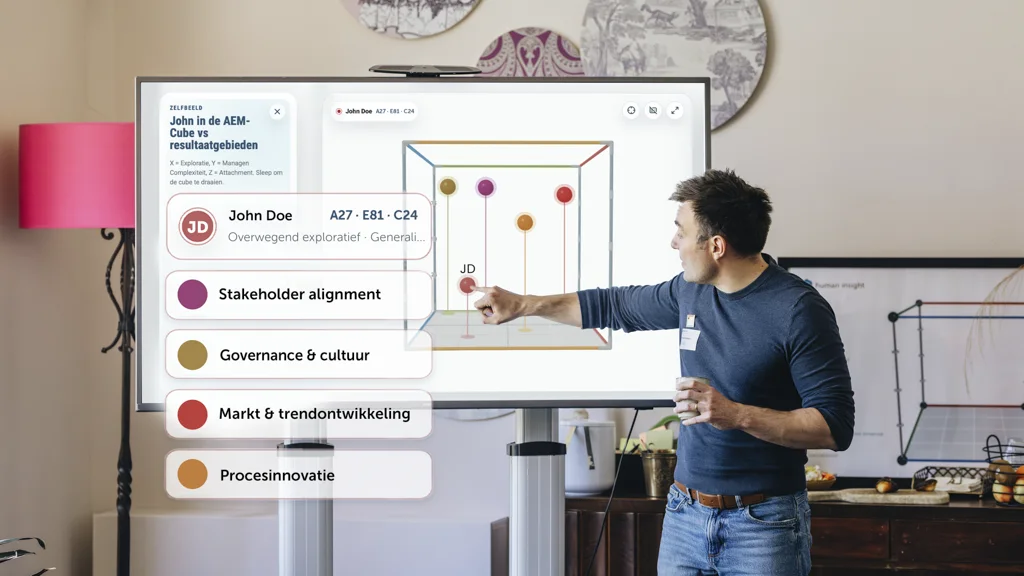
Results are presented in clear, actionable reports at individual, team and organisational levels, visualising the behaviours and interactions across your scope.
Translate into action
Reports can be used in leadership programmes, team sessions and talent discussions to inform behaviours, interactions, collaboration and development priorities.
Comprehensive reporting and insights
The Quality of Interaction assessment offers structured insight at individual, team and organisational levels.
iQi reports
- Personal behavioural profile with detailed explanations.
- Visual representation of interaction preferences.
- Development insights and practical applications.
- Collaboration strategies based on behavioural styles.
TeamQi reports
- Perceived behavioural mapping for your team.
- Current and desired interaction analysis.
- Collaboration patterns and potential friction points.
- Team development recommendations.
Organisation Qi reports
- Perceived behavioural mapping across your company.
- Current and desired interaction analysis.
- Collaboration patterns and potential friction points.
- Organisational development recommendations.
Trusted by organisations and institutions worldwide
AEM-Cube is grounded in over 30 years of behavioural science and used across industries.

Research Foundation
- Evidence-based behavioural frameworks linking insight to business performance.
- Referenced in academic and management literature.
- Proven impact on alignment, adaptability and sustainable growth.
30+
Years of validated assessments
20+
Years of research
80,000+
Supported individuals
1,200
Organisational applications worldwide


Frequently asked questions
What is the Quality of Interaction (Qi) assessment?
The Quality of Interaction (Qi) assessment shows how effectively people interact, collaborate and respond to change. It measures cognitive diversity, psychological safety and the generative factor to reveal how well a team or organisation uses different perspectives, creates openness and adapts to challenges.
What does Quality of Interaction measure?
Quality of Interaction measures three dimensions of group dynamics. Cognitive diversity shows how people differ in the way they think and solve problems. Psychological safety shows whether people feel safe enough to express ideas, concerns and different perspectives. The generative factor shows how capable a team or organisation is of responding to challenges, innovating and acting with agility.
What is the difference between cognitive diversity and psychological safety?
Cognitive diversity is about differences in thinking style, perspective and problem-solving approach. Psychological safety is about whether people feel safe enough to express those differences. Qi measures both, because cognitive diversity only creates value when people feel able to speak up, challenge ideas and contribute openly.
How is Qi typically used?
Qi is typically used in team development, leadership coaching, board development and organisation-wide change programmes. It helps teams understand how they communicate, where interaction patterns block progress and which behaviours can strengthen collaboration, adaptability and decision-making.
How long does the Qi assessment take?
The Qi questionnaire usually takes around 10 minutes per participant. Results are analysed at group level, so the focus is on team dynamics, interaction patterns and organisational behaviour rather than judging individual performance.
Contact Information
Tell us briefly what you are looking to improve, explore, or solve. Our team will review your request and get back to you with relevant information or next steps.
If your inquiry relates to a potential project, partnership, or service, include a few details about your company and goals so we can respond more effectively.
Ready to strengthen behaviours and interactions in your organisation?
Reach out to learn more about Qi, how it works and what it can do for you, or just to share ideas.